
Katalyst Wins OECIF Contract for On-Orbit Power Beaming

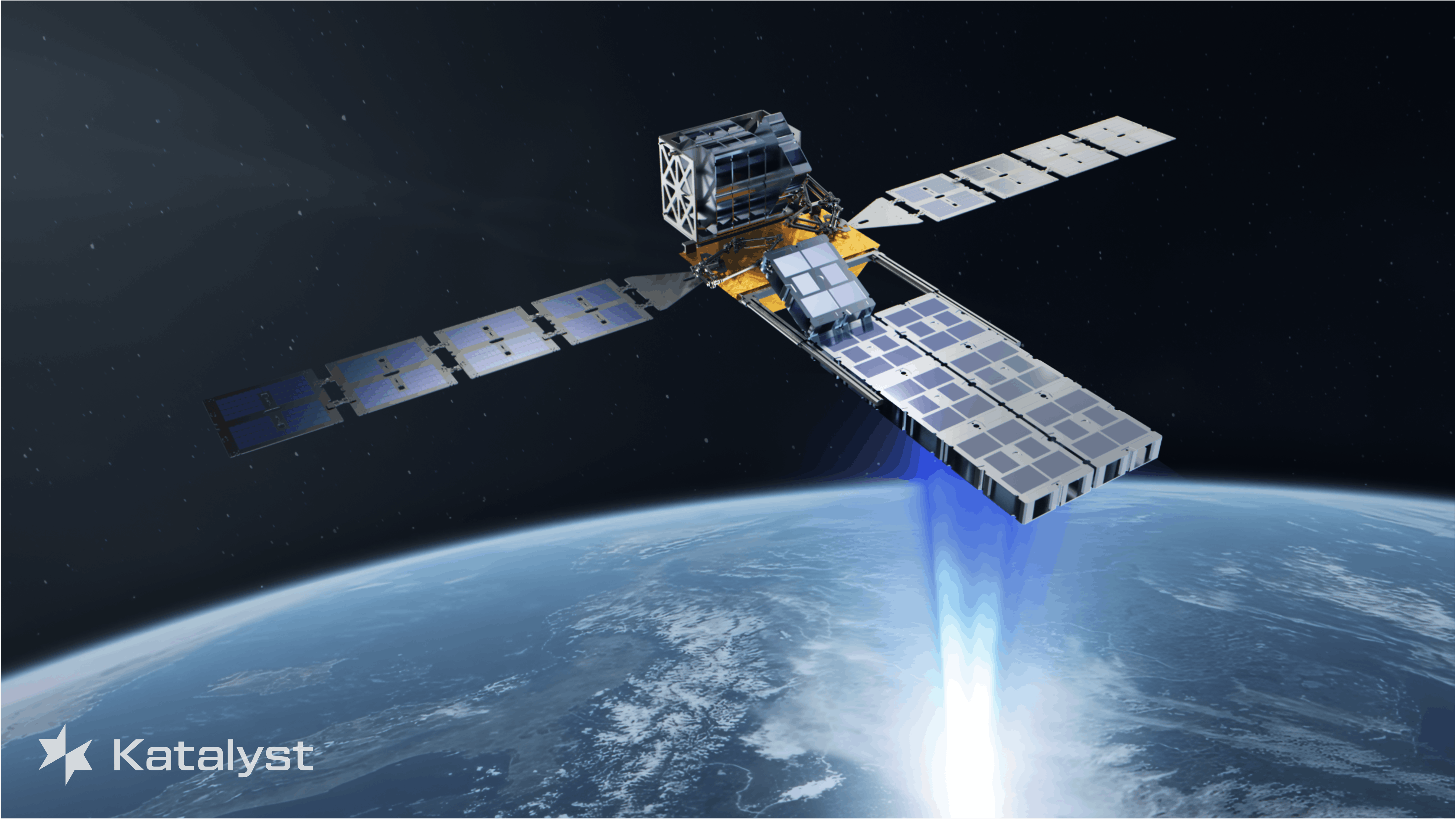
Katalyst will demonstrate on-orbit assembly of large-scale infrastructure for space-based solar power
BROOMFIELD, Colo. — September 21, 2026 —Katalyst Space announced its selection by the Operational Energy Capability Improvement Fund (OECIF) to demonstrate space-based power beaming to remote locations. Under the Advanced Scalable Growth Architecture for Robotic Deployment (ASGARD) program, Katalyst will develop and launch a robotic spacecraft that will assemble a large-format power beaming system on orbit and transmit power back to Earth.
At the center of the effort is Katalyst’s NEXUS platform, a multi-mission robotic spacecraft designed to provide the mobility, manipulation, and autonomy needed to build and operate complex systems in space.
“A multi-mission, multi-use robotic spacecraft is a key enabler that makes capabilities like power beaming possible,” said Ghonhee Lee, CEO of Katalyst Space. “By combining capabilities like robotics, capture, and assembly on a single platform, the NEXUS platform supports a broad range of applications.”
Space-based energy generation has the potential to deliver power directly to remote operational locations, disaster areas, or regions where the grid is constrained or disrupted—without relying on fuel supplies, generation, or traditional terrestrial infrastructure. Reducing dependence on legacy energy sources strengthens national security while enabling resilient power for on-orbit missions and future space and lunar exploration. This will advance OECIF’s focus on delivering energy resilience to warfighters in operational environments for the Department of War.
“This important, first-of-a-kind technology opens new pathways for operational energy in space,” Director of Operational Energy – Innovation RuthAnne Darling said. “Demonstrating this groundbreaking technology, autonomously assembling large-scale power and energy collectors in space, is the first step and a foundational one.”
Power-beaming at scale requires structures that exceed the volume constraints of a single launch vehicle. On-orbit assembly addresses this challenge by launching the unassembled components and assembling them on orbit, creating a scalable path toward expanding space infrastructure. The U.S. Naval Research Laboratory (NRL) has a long history of advancing space robotics and pioneering technologies that reinforce American leadership in space. NRL has developed breakthrough direct current-to-microwave conversion technology that makes large-scale space-based power beaming commercially and operationally viable.
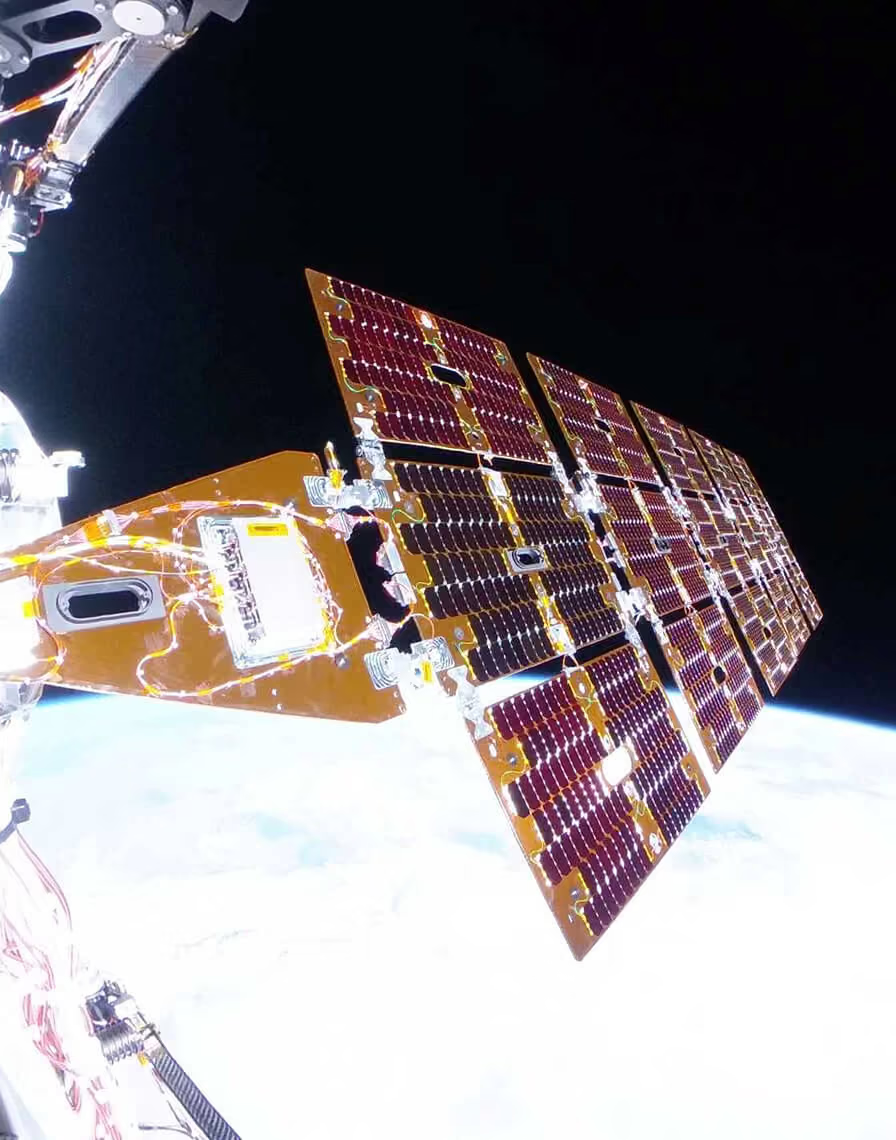
For ASGARD, NEXUS will launch to low Earth orbit (LEO) with modular tiles currently in development by NRL, under OECIF funding. NEXUS will use its robotic arms to assemble these tiles on-orbit, creating a large-format power beaming system. Once assembled, the NRL-designed tiles will collect solar energy, convert it into radio frequency microwave energy, and transmit that energy to Earth. This will be one of the largest demonstrations of on-orbit assembly and operation of power-beaming infrastructure.
“Advancing space-based power beaming requires successful partnerships between government and industry,” said Acting Director of NRL’s Naval Center for Space Technology, Bernard Kelm. “OECIF is a great example of how leveraging public-private partnerships can accelerate the delivery of on-orbit capabilities.”
“We are excited to partner with NRL on the ASGARD program, and leverage NRL’s expertise to create a quicker path towards operational deployment,” said Lee. “Robotic servicing is enabling a wholesale change of space operations, including power beaming. The system is designed from the outset to be resupplied, expanded, and scaled over time. We envision a future where this capability grows from kilowatts to megawatts, providing resilient power at scale.”
About Katalyst Space
Katalyst Space is an American defense technology company. Founded in 2020, Katalyst is building a fleet of autonomous robotic space vehicles capable of docking to unlock new life and new missions.
NEXUS is Katalyst’s flagship spacecraft, designed to manipulate objects in space, moving beyond static, single-use assets to dynamic, multi-use, multi-mission spacecraft. NEXUS advances Katalyst’s vision for the future of dynamic space operations.
About OE-I
The Operational Energy – Innovation (OE-I) Directorate operates in collaboration with the Services and Combatant Commands and is structured to leverage – not replicate – the existing infrastructure and organization to develop joint and interoperable technologies. Each Agency’s operational energy lead works collectively with the OECIF and OEPF programs to develop, select, and oversee investments and transitions.
About NRL
NRLis a scientific and engineering command dedicated to research that drives innovative advances for the U.S. Navy and Marine Corps from the seafloor to space and in the information domain. NRL, located in Washington, D.C. with major field sites in Stennis Space Center, Mississippi; Key West, Florida; Monterey, California.
NRL offers several mechanisms for collaborating with the broader scientific community, within and outside of the Federal government. These include Cooperative Research and Development Agreements (CRADAs), LP-CRADAs, Educational Partnership Agreements, agreements under the authority of 10 USC 4892, licensing agreements, FAR contracts, and other applicable agreements.

.png)

.avif)